
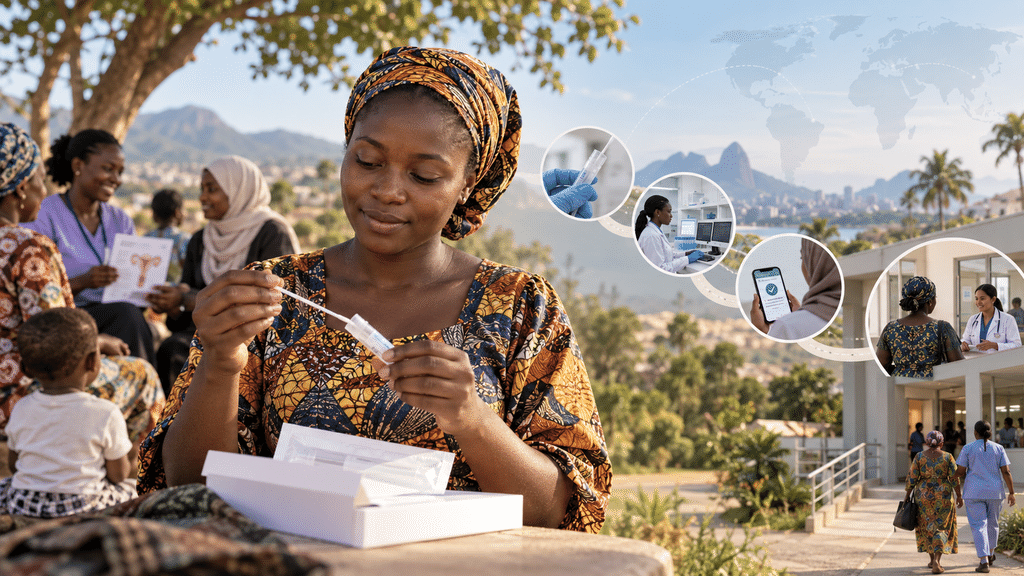
HPV self-sampling changes a familiar assumption in cervical-cancer screening: a woman does not necessarily have to begin with a conventional pelvic examination in a clinic. Collecting a sample herself can reduce barriers related to privacy, embarrassment, travel, clinic time and provider availability. That can widen the front door to screening.
But the biological pathway does not end when a sample is collected. A positive HPV result still requires reliable laboratory processing, result communication, risk assessment, triage and, where indicated, treatment. This creates a paradox: a programme can succeed in reaching more women while simultaneously enlarging the number who need a downstream system that may already be weak. Self-sampling can therefore move a bottleneck rather than eliminate it.
Studies and participatory projects in Tanzania and remote Canadian communities illustrate why the delivery model matters as much as the kit. Communication has to explain what HPV means, women need to know what will happen after testing, laboratories and data systems must return results reliably, and navigation must connect positive results to the next clinical step. The strongest model treats self-sampling as a different entry point into the same complete prevention pathway.
Publications behind this Insight
Risk Communication, HPV Knowledge and Self-Sampling Among Women in Tanzania
Risk Communication, HPV Knowledge and Self-Sampling Among Women in Tanzania. 2025. 10.24908/iqurcp18918.
Open publicationA Health-Systems Appraisal of Cervical-Cancer Prevention Services in Tanzania
Melinda Chelva, Sanchit Kaushal, Nicola West, Erica Erwin, Safina Yuma, Jessica Sleeth, Khadija I. Yahya-Malima, Donna Shelley, Isabelle Risso-Gill, Karen Yeates. “In the Village That She Comes from, Most of the People Don’t Know Anything about Cervical Cancer”: A Health Systems Appraisal of Cervical Cancer Prevention Services in Tanzania. International Journal of Environmental Research and Public Health. 2024. DOI 10.3390/ijerph21081059.
Open publicationBeyond the Screening Test: Building Cervical Cancer Prevention with Indigenous Communities
Nicola West, Sara Medina Kasani, Elaine Innes, Khadyn Butterfly, Sandra Kioke, Erica Groenewoud, Enza Ferrara, Karen Yeates. Moving towards equitable cervical cancer screening for indigenous peoples. Open Access Government. 2026. DOI 10.56367/OAG-052-12536.
Open publicationSmarter Diagnostics, Wider Access: Bringing Cervical Cancer Prevention Within Reach
Meara Sanjayan, Nicola West, Christine Ha, Federica Inturrisi, Silvia de Sanjosé, Davis Amani, Jackline Ngowi, Pacifique Ndishimye, Karen Yeates. AI and molecular diagnostics: A revolution for cervical cancer equity. Open Access Government. 2026. https://www.openaccessgovernment.org/ebook/ai-and-molecular-diagnostics-a-revolution-for-cervical-cancer-equity/214436/.
Open publicationEvidence behind this Insight
- 1. Sanjayan M. HPV knowledge, risk communication and self-sampling in Tanzania. 2025. DOI 10.24908/iqurcp18918. Risk Communication, HPV Knowledge and Self-Sampling Among Women in Tanzania
- 2. Chelva M, et al. 2024. DOI 10.3390/ijerph21081059. A Health-Systems Appraisal of Cervical-Cancer Prevention Services in Tanzania
- 3. Government of Canada. Listening to Our Women: HPV DNA self-sampling among Indigenous women living remotely in Ontario. 2024. WEMA Project
- 4. Nicola West, et al. Moving towards equitable cervical cancer screening for indigenous peoples. Open Access Government. 2026. DOI 10.56367/OAG-052-12536. Beyond the Screening Test: Building Cervical Cancer Prevention with Indigenous Communities
- 5. Meara Sanjayan, et al. AI and molecular diagnostics: A revolution for cervical cancer equity. Open Access Government. 2026. https://www.openaccessgovernment.org/ebook/ai-and-molecular-diagnostics-a-revolution-for-cervical-cancer-equity/214436/. Smarter Diagnostics, Wider Access: Bringing Cervical Cancer Prevention Within Reach