
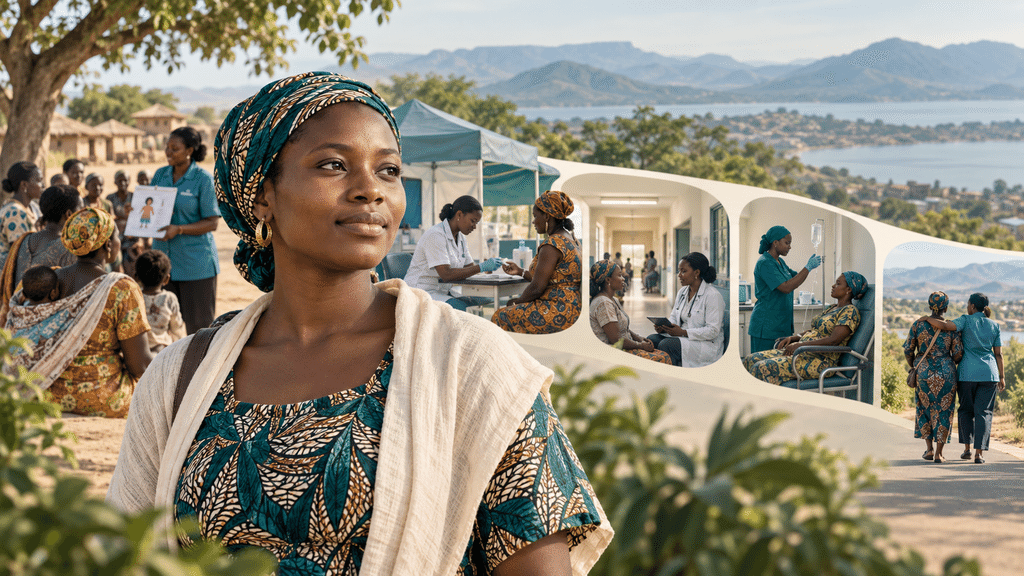
Cervical-cancer prevention is often described through screening coverage: how many women were invited, tested or reached. Those numbers matter, but they describe only the beginning of a prevention pathway. A programme can identify women at risk and still fail to prevent cancer if results are delayed, referral is difficult, treatment is unavailable, or women disappear from care between one stage and the next.
Research in Tanzania and the wider region makes this continuum visible. Health-system appraisals show that screening decisions are shaped by service availability, trained providers, understandable information, distance, financing and the organization of referral. Implementation studies of smartphone-supported supervision, self-sampling, community outreach and navigation show that technology can remove particular barriers, but improvements at one stage often expose the weakness of another. A more useful implementation question is therefore whether a health system can carry a woman from first contact to completed preventive care.
That changes what programmes should measure. Invitation and screening remain important, but so do result communication, triage, referral completion, treatment and follow-up. A strong screening programme is not simply one that finds more women; it is one that makes losses between stages visible and then redesigns the pathway around them.
Publications behind this Insight
A Health-Systems Appraisal of Cervical-Cancer Prevention Services in Tanzania
Melinda Chelva, Sanchit Kaushal, Nicola West, Erica Erwin, Safina Yuma, Jessica Sleeth, Khadija I. Yahya-Malima, Donna Shelley, Isabelle Risso-Gill, Karen Yeates. “In the Village That She Comes from, Most of the People Don’t Know Anything about Cervical Cancer”: A Health Systems Appraisal of Cervical Cancer Prevention Services in Tanzania. International Journal of Environmental Research and Public Health. 2024. DOI 10.3390/ijerph21081059.
Open publicationBeyond the Screening Test: Building Cervical Cancer Prevention with Indigenous Communities
Nicola West, Sara Medina Kasani, Elaine Innes, Khadyn Butterfly, Sandra Kioke, Erica Groenewoud, Enza Ferrara, Karen Yeates. Moving towards equitable cervical cancer screening for indigenous peoples. Open Access Government. 2026. DOI 10.56367/OAG-052-12536.
Open publicationSmarter Diagnostics, Wider Access: Bringing Cervical Cancer Prevention Within Reach
Meara Sanjayan, Nicola West, Christine Ha, Federica Inturrisi, Silvia de Sanjosé, Davis Amani, Jackline Ngowi, Pacifique Ndishimye, Karen Yeates. AI and molecular diagnostics: A revolution for cervical cancer equity. Open Access Government. 2026. https://www.openaccessgovernment.org/ebook/ai-and-molecular-diagnostics-a-revolution-for-cervical-cancer-equity/214436/.
Open publicationEvidence behind this Insight
- 1. Chelva M, et al. Health-systems appraisal of cervical-cancer prevention services in Tanzania. 2024. DOI 10.3390/ijerph21081059. A Health-Systems Appraisal of Cervical-Cancer Prevention Services in Tanzania
- 2. Rivero-Mendoza D, et al. Health-system strategies to improve cervical-cancer screening uptake in sub-Saharan Africa. 2026. DOI 10.1177/15248399251370668. External evidence
- 3. Daniels-Donkor SS, Marryat L. Health-system barriers and facilitators for cervical screening in sub-Saharan Africa. 2026. DOI 10.1186/s12913-026-14003-5. External evidence
- 4. Nicola West, et al. Moving towards equitable cervical cancer screening for indigenous peoples. Open Access Government. 2026. DOI 10.56367/OAG-052-12536. Beyond the Screening Test: Building Cervical Cancer Prevention with Indigenous Communities
- 5. Meara Sanjayan, et al. AI and molecular diagnostics: A revolution for cervical cancer equity. Open Access Government. 2026. https://www.openaccessgovernment.org/ebook/ai-and-molecular-diagnostics-a-revolution-for-cervical-cancer-equity/214436/. Smarter Diagnostics, Wider Access: Bringing Cervical Cancer Prevention Within Reach